
Reaching for a
Vanished World
Reaching for a Vanished World draws inspiration from the everyday lives of Central and Eastern European Jewry in the years preceding the Holocaust. Photographs from Yiddishland, Henri Minczeles and Gerard Silvain's time-capsule of a book, form the primary inspiration for my collection. I imagine a little girl unveiling an old chest. She pulls out overcoats, dresses, and little boys' shirts and piles them on. I wish she were me and I wish there were more left to hold in my hands. In my work I use salvaged textiles, locally sourced wool, and botanical dyes.


In the words of Jacob Glatstein–
I am searching for the dust in your dust.
Reaching for a Vanished World, my capstone Autumn/Winter fashion collection, pulls the legacy of Yiddishland into contemporary discourse. Each heirloom represents a thread of a world long gone, but carried forward with stories and melded memories. The collection draws inspiration from photographs of everyday Jewish shtetl life in the Pale of Settlement, in the years preceding the Holocaust.
Book Pages
Laid out on a preliminary sketch of my own
Silvain, Gérard, and Henri Minczeles. Yiddishland. Hazan, 1999.


Constructing garments in a shtetl–fraught as they often were with poverty–was made possible by resourcefulness and community support. This collection is made in the same spirit.
Many of the garments worn in Yiddishland were humble and made for ease of labor. Natural fiber textiles that retain quality with wear, hand embroidery, and sturdy construction will make my collection suitable for life and labor. I am using locally and ethically sourced natural materials: accessories upcycled from damaged coats; bespoke textiles felted from local wool; garments cut-and-sewn from repurposed textiles; and natural dyes foraged from the local ecosystem.
Color & Swatch Exploration
In paint & organic pigments
Yiddishland is shrouded in a veil of shadow. Chromatic grays and browns capture the distance and fadedness of shtetl life while retaining the warmth and movement of a bustling past.

#836242
#ccbfb4
#a69397
#716c80
#727f9b
#7f7d8c
#675649
#77676c
#784b4d
#363042
#36803b
#4a546d
Design Development
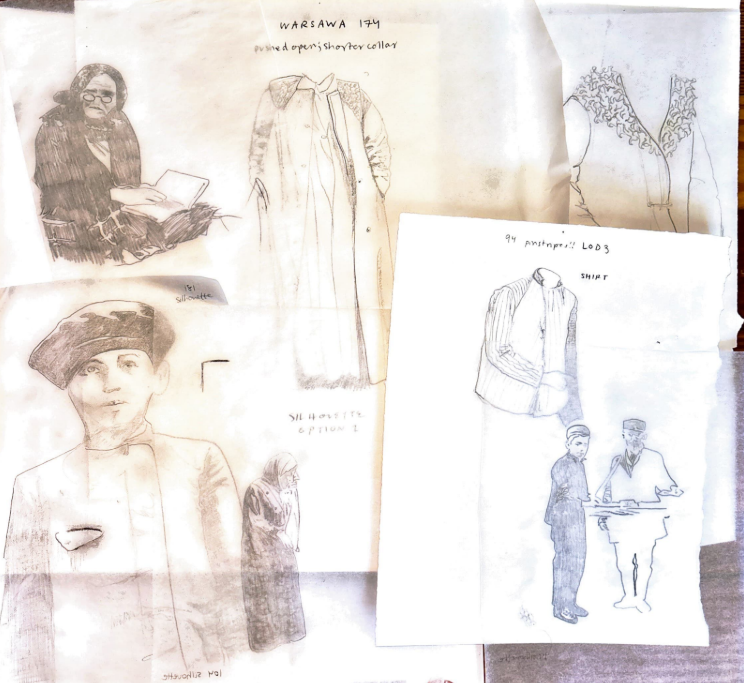


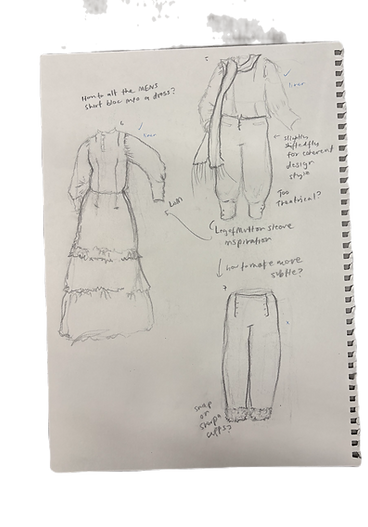


Exploring Theme & Character Through Screen Printing


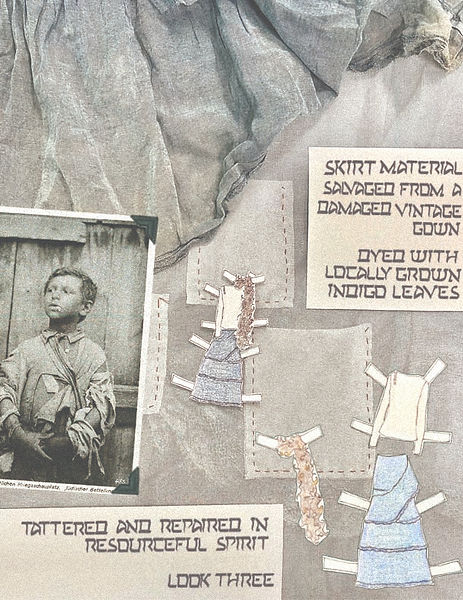


Felted Textile Development
I developed my own custom felted textiles using raw Icelandic wool from Steep Hollow Farm in Ithaca, NY.
.jpg)
Meeting the sheep
.jpg)
Introducing myself to Tupelo, whose wool I worked with
.jpg)
Skirting (removing plant matter from) his fleece

Skirting another fleece from Tamarack, who is Tupelo's mother
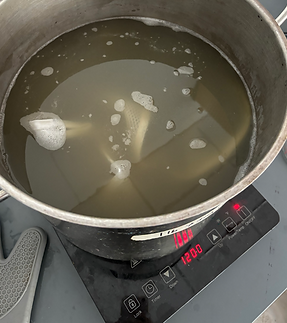
Scouring (intensively washing in cycles of heat and soap) in many batches

Laying the clean wool to dry on screen doors

Knitting a tension swatch, experimenting with felting technique, & developing a schematic drawing accordingly
.jpg)
Knitting the foundation of the coat in panels according to the schematic drawing

Felting the dried wool on top of the wool layers in panels as trim

Inspecting a felted panel

Experimenting with a similar process, felting wool over the entire panel for my cropped coat
_HEIC.png)
Final step: hand linking the panels together to form coats

Botanical Dyes
Reaching for a Vanished World incorporates locally foraged black walnut, and indigo from a local Upstate New York farm. I honed my natural dying and mordanting skills working as a research assistant for “Designing for Health an Longevity: Evaluating and Improving Colorfastness and Antimicrobial Properties of Fabrics Dyed with Biowaste and Weeds”
a faculty research project at Cornell University that explored diverting local agricultural waste and invasive species into natural dye materials.

Black Walnut
Foraging Black Walnut from trees in Ithaca, NY.

Black Walnut
Dying a white linen jacket and woven scarf in a Black Walnut dye bath. I supplemented the dye bath with iron powder in order to darken the color.

Black Walnut
Hanging the jacket to dry to inspect the coloration.

Indigo
Creating indigo dye vat with dried local indigo leaves, calcium hydroxide, and fructose. Finally seeing the indigo "bloom" form at the top.

Indigo
Experimenting with oxidizing swatches and adjusting ratios.

Indigo
Watching the freshly dipped dress turn from teal to blue as it reacts with oxygen.


Cutting the revised pattern pieces for the look four jacket | soon to be dyed with Black Walnut.

I gleaned visual inspiration from books, archives, and museums while researching Jewish History in Central Europe.


Marketing: Process and Plan
This collection will appeal to Jews of the diaspora who wonder about the streets their predecessors wandered. Of course, this is not only a collection for Jews. Contemporary heirlooms appeal to fashion consumers looking to acquire ethically produced, storied garments to keep them warm in the colder season.
Vintage and bespoke textiles and hand sewn details place these garments in the bridge price range. Relaxed silhouettes make the collection wearable by both men and women. However, the garments will be modeled on female bodies which may encourage more women to purchase them. It is feasible–and advisable–to produce this collection in a small collaborative atelier in the United States. Being primarily cut and sew, woven garments, the US has the infrastructure to support their production.
Collaborative exhibits with Jewish Museums and textile archives pose a unique marketing opportunity. Working with educational institutions underlines the collection’s conceptual skeleton. When consumers ruminate on the material traces of our lives, they will feel encouraged to engage with history through dress.

Acknowledgments
I would like to extend my deepest gratitude to my professors; to Christianne White of Steep Hollow Farm, for giving me her sheep's wool; Mimi Prober, my incomparable mentor for taking me under her wing and teaching me to use the felt loom; my amazing models and kind, inventive, industrious, classmates; and Cascade Yarns for donating the yarn I used in my felted coats. They model the community values I seek to uphold in my own life and work.